How To Confirm A Butt Weld Tee Bonds Properly With Pipeline Sections?
A pipeline can look perfectly assembled and still fail months later. The real test isn't visual — it's what happens at the seam once pressure, heat, and vibration are added to the equation.
Why Pipe-to-Fitting Connections Fail More Often Than Expected
Most leaks don't start as leaks. They start as small gaps in alignment that grow under thermal cycling. A joint that looks flush at installation can shift once the system reaches operating temperature.
In reviews of early-life pipeline failures, misaligned joints and inconsistent bevel angles account for a large share of reported leaks — often before the first year of service ends.
Common Fitting Types Used in Pressure Piping
Fittings for Equal-Diameter Runs
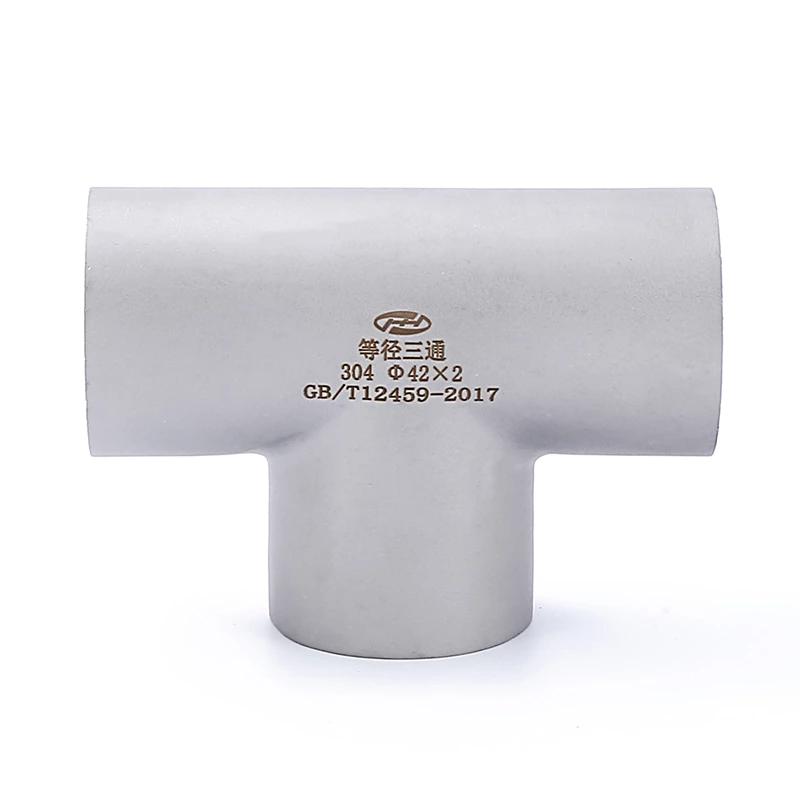
A butt weld tee joins three pipe sections of matching diameter at a branch point. It's the default choice where flow needs to split without changing pipe size, and it's welded directly to the pipe ends rather than threaded or socketed.
Fittings for Diameter Transitions
When the branch line runs a smaller diameter than the main run, a butt weld reducing tee handles the transition in one fitting instead of adding a separate reducer. This reduces the number of welds — and the number of potential failure points.
The Broader Category
Weld tees, as a category, cover both equal and reducing configurations, along with variations in wall thickness and pressure class. Choosing within this category depends less on shape and more on how the fitting will behave once welded into place.
Checking Dimensions Before Any Weld Begins
Dimensional mismatch is one of the most preventable causes of joint failure, yet it's frequently skipped during fast-paced installs.
| Fitting Schedule | Nominal Wall Thickness | Typical Bevel Angle | Acceptable OD Tolerance |
|---|---|---|---|
| Schedule 40 | 3.9 mm | 37.5° | ±0.4 mm |
| Schedule 80 | 5.5 mm | 37.5° | ±0.4 mm |
| Schedule 160 | 8.7 mm | 30°–37.5° | ±0.5 mm |
A one-degree bevel mismatch may seem trivial, but across a full weld pass it can leave a root gap wide enough to trap slag or cause incomplete fusion.
Material Behavior Under Heat and Pressure
A stainless steel tee reacts differently to welding heat than carbon steel does. Chromium content affects how quickly the heat-affected zone cools, and rapid cooling can leave the metal vulnerable to carbide precipitation at the grain boundaries.
Matching filler metal grade to the base fitting — not just approximating it — keeps corrosion resistance consistent across the joint, not just within the parent pipe.
A Practical Verification Checklist
-
Confirm outer diameter and wall thickness match on both sides of the joint.
-
Inspect bevel angle with a gauge, not by eye.
-
Check root gap consistency around the full circumference.
-
Verify filler metal certification matches the base material grade.
-
Run a post-weld dye penetrant or radiographic check on critical lines.
-
Document heat input to catch deviations from the welding procedure.
Mistakes That Quietly Undermine a Connection
-
Assuming two fittings from different batches share identical tolerances.
-
Skipping a dry fit before tacking the joint in place.
-
Using a general-purpose filler rod instead of a grade-matched one.
-
Relying on visual inspection alone for high-pressure service lines.
Quick Answer
A pipe-to-fitting joint is considered properly connected when the outer diameters align within tolerance, the bevel angles match on both sides, the root gap stays consistent around the full circumference, and the filler metal grade corresponds to the base material — verified before and after welding, not assumed from the fitting's spec sheet alone.
Getting each of these checks right before the first weld pass costs a few extra minutes. Catching a failure after installation costs considerably more — in downtime, material, and rework.