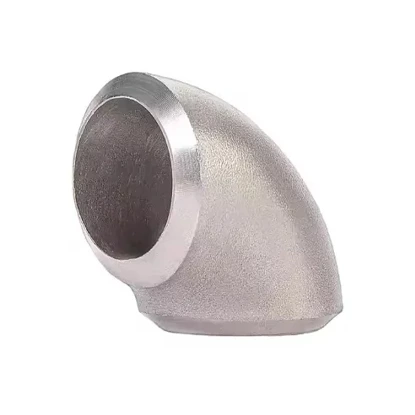
The Forming Process Of Stainless Steel Elbows
3 4 stainless steel 90 degree elbow are widely used in pipeline engineering, serving as components that connect two pipes and bend them. Their main function is to change the flow direction of the pipeline, thus they are widely used in various industrial and construction projects. This article will detail the forming process of stainless steel elbows to help readers understand this crucial manufacturing step.
Material Selection for Stainless Steel Elbows
stainless pipe elbows typically use materials with good corrosion resistance, such as 304 stainless steel and 316 stainless steel. These stainless steel materials possess high temperature resistance, oxidation resistance, and corrosion resistance, making them suitable for various harsh working environments.
Production Process of Stainless Steel Elbows
The forming process of 1 1 2 steel elbow involves multiple steps, from material preparation to final forming and inspection, each step being crucial. Below are common stainless steel elbow forming processes:
(1) Cold Bending Forming
Cold bending forming is a commonly used method for manufacturing 1.5 90 degree elbow steel. This process involves bending stainless steel pipes at room temperature using a pipe bending machine to achieve a predetermined angle. The advantages of cold bending are lower processing costs and the elimination of the need for heating equipment, making it more economical.
The steps for cold bending are as follows:
-
Pipe cutting: According to design requirements, first cut the stainless steel pipe to the required length.
-
Setting the bending angle: Adjust the pipe bending machine to set the angle and radius of the bend, ensuring it meets design requirements.
-
Bending: Use the pipe bending machine to cold bend the pipe, forming the required curved shape under pressure.
(2) Hot bending
Hot bending is typically used for stainless steel elbows requiring larger bending angles or larger pipe diameters. In this process, the pipe is heated to a certain temperature, giving it better plasticity, allowing bending to be completed with lower force.
The steps for hot bending are:
-
Heating the pipe: Heat the stainless steel pipe to an appropriate temperature, usually around 850℃, using a flame, furnace, or other means.
-
Bending: Apply pressure to the heated pipe to bend it at the designed angle.
-
Cooling and shaping: After bending, cool the 6 stainless steel 90 degree elbow to room temperature to ensure shape stability.
(3) Extrusion Molding
Extrusion molding is a process in which stainless steel pipes are plastically deformed under high pressure using a die. This process is commonly used to produce large-diameter, high-precision stainless steel elbows, and is particularly suitable for mass production.
The extrusion molding process includes:
-
Die Design: A suitable die is made according to requirements, containing a predetermined bending shape.
-
Heating and Extrusion: The stainless steel pipe is heated to a suitable temperature and then fed into an extruder, where it is extruded through the die to form the elbow shape.
-
Cooling and Finishing: After extrusion, the elbow needs to be cooled and finished to ensure dimensional accuracy.
3. Welding Forming of Stainless Steel Elbows
For some large-diameter or complex-shaped 4 inch stainless steel 45 degree elbow, welding may be necessary. This method is mainly used to produce elbows with specific joints or connection types.
The welding process includes:
-
Pipe Pretreatment: The stainless steel pipe is first cut and ground.
-
Welding Operation: The two ends of the pipe are butt-jointed and welded using methods such as TIG welding (tungsten inert gas welding) to form the elbow shape.
-
Heat Treatment and Stress Relief: After welding, heat treatment is performed to ensure no stress concentration at the weld joint and that the elbow's strength and corrosion resistance meet standards.
4. Inspection and Quality Control of Stainless Steel Elbows
After the tri clamp elbow is formed, rigorous quality inspection is crucial. Common inspection items include:
-
Dimensional Inspection: Using calipers, gauges, and other tools, check if the elbow's outer diameter, inner diameter, bending angle, and radius meet design requirements.
-
Surface Inspection: Inspect the elbow surface for defects such as cracks, porosity, and scratches, ensuring a smooth and flawless surface.
-
Pressure Testing: Conduct high-pressure water tests on the elbow to ensure it can withstand the pressure within the pipeline during actual use.
5. Post-Processing of Stainless Steel Elbows
The formed 1 1 4 stainless steel elbow requires post-processing to improve its corrosion resistance and appearance quality. Common post-processing methods include:
-
Polishing: Improve the surface finish of the elbow through mechanical or chemical polishing.
-
Pickling and passivation: The elbow is immersed in pickling solution to remove surface oxide scale and enhance corrosion resistance.
-
Coating treatment: Depending on the needs, a coating treatment can be applied to the elbow surface to further improve its durability.
Summary
The forming process of stainless steel elbows involves multiple steps, encompassing different processes such as cold bending, hot bending, extrusion forming, and welding forming, each with its unique application scenarios. Through the precise operation of these processes, 1 inch stainless steel 90 degree elbow can meet the needs of various industrial sectors for pipe connection components. During production, strict quality control and post-processing technologies ensure the high quality and long-term performance of the elbows.