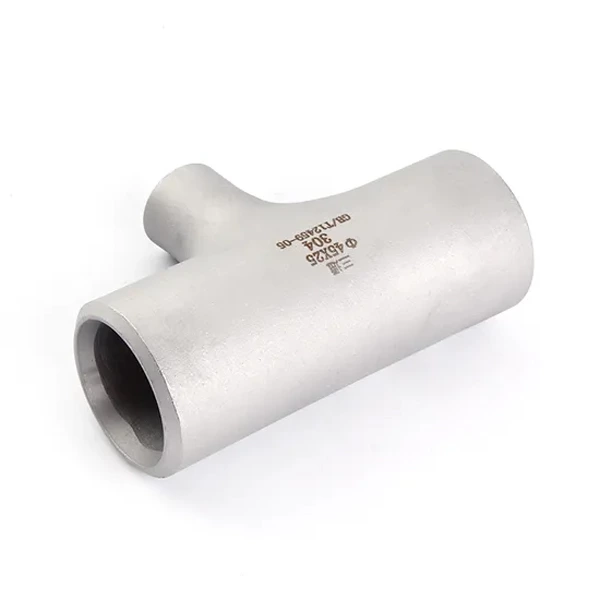
Comparison Of Process Differences And Usage Scenarios Of 304/316 Stainless Steel Tees
2 steel tee are common connectors in piping systems, typically used to connect three pipes together to form a "T" shape. Tees are widely used in industrial, construction, and chemical industries. 304 and 316 3 4 steel tee are two common materials, differing in chemical composition, corrosion resistance, and strength, thus leading to some differences in application scenarios and manufacturing requirements.
I. 304 Stainless Steel Tees
304 stainless steel is the most common austenitic stainless steel, widely used in everyday industrial applications. Containing 18% chromium and 8% nickel, 304 stainless steel exhibits good corrosion resistance, good formability, and weldability. Its main characteristics are good heat resistance and oxidation resistance, making it suitable for most non-extreme environments.
Processing characteristics of 304 stainless steel tees:
-
Good formability and machinability: 304 stainless steel has relatively good formability and machinability, allowing for manufacturing through welding, stamping, and other processes.
-
Good weldability: 304 stainless steel has good weldability, resulting in high-strength welded joints, suitable for connecting complex piping systems.
-
Corrosion Resistance: Suitable for most industrial environments, especially applications less sensitive to oxidation and corrosion, such as food processing and domestic water systems.
-
Heat Resistance: Good temperature resistance, but the corrosion resistance of 304 stainless steel will decrease in high-temperature environments (such as long-term exposure to environments exceeding 600℃).
Applications of 304 Stainless Steel Tees:
-
Food Processing: Due to its good hygiene and corrosion resistance, 304 stainless steel is widely used for pipe connections in the food and beverage processing industry.
-
Construction Industry: Due to its corrosion resistance and good weldability, 304 3 8 stainless steel tee are commonly used in building water supply and drainage systems.
-
General Industry: 304 3 8 stainless tee can also be used in some non-corrosive or mildly corrosive environments, such as in general chemical, machinery, and automotive industries.
II. 316 Stainless Steel Tees
316 stainless steel is based on 304 stainless steel with the addition of 2%–3% molybdenum, which greatly enhances its corrosion resistance, especially its resistance to chlorides (such as seawater and brine). 316 stainless steel is widely used in marine environments, chemical handling, and other applications with highly corrosive media.
Processing characteristics of 316 stainless steel tees:
-
Excellent corrosion resistance: 316 stainless steel has stronger corrosion resistance than 304 stainless steel, especially against chlorides, making it suitable for environments with strong acids and alkalis.
-
Processing and weldability: Similar to 304 stainless steel, 316 stainless steel also has good processability and weldability. However, due to its molybdenum content, care must be taken to prevent excessive oxidation of molybdenum during welding.
-
Strength and heat resistance: 316 stainless steel maintains good mechanical properties at high temperatures, and its heat resistance is slightly better than that of 304 stainless steel.
-
Corrosion resistance and oxidation resistance: 316 stainless steel also has good oxidation resistance at high temperatures, making it suitable for high-temperature corrosive environments.
Applications of 316 stainless steel tees:
-
Marine environment: Due to its excellent resistance to chloride corrosion, 316 316 tee are commonly used in seawater desalination, offshore oil platforms, and ship pipelines.
-
Chemical and Pharmaceutical Industries: In highly corrosive environments such as chemical reactions and acid/alkali treatments, 316 6 stainless steel tee possess exceptional corrosion resistance, ensuring long-term stable use.
-
High-Temperature Environments: Under high-temperature conditions, including steam, 316 stainless steel maintains excellent performance, making it suitable for connections in high-temperature chemical and industrial equipment.
Summary
304 and 316 ss 304 tee differ significantly in their manufacturing processes and application scenarios. 304 stainless steel, due to its good formability, machinability, and moderate price, is widely used in food processing, building water supply and drainage, and other fields. In contrast, 316 stainless steel, with its superior corrosion resistance and high-temperature resistance, is particularly suitable for marine environments, chemical handling, and other highly corrosive environments.
The choice between 304 and 316 ss reducing tee should be based on the specific corrosive environment, temperature requirements, and budget. For common non-corrosive environments, 304 stainless steel is sufficient; however, in harsh environments, 316 stainless steel is more suitable.