Heavy-Wall Large-Diameter Butt Weld Cap Process Matrix: Hot Pressing vs Cold Spinning
Process selection for a heavy-wall large-diameter butt weld cap relies on dimensions. Plates exceeding 25mm thickness or 600mm diameter require hot press forming to prevent mechanical stress, whereas thinner profiles utilize cold spinning or hydraulic deep drawing.
Selecting production methods requires evaluating the ratio between outside diameter and nominal wall thickness. Heavy cross-sections resist room-temperature deformation, making tonnage requirements escalate beyond typical press capacities during unheated forming cycles.
Process Boundaries Across Diameter and Thickness
Hot press forming dominates components with diameters above NPS 24 or wall thickness beyond Schedule 80. Heating blanks above austenitizing temperatures lowers yield strength, enabling single-stroke hydraulic forming without inducing localized micro-cracks or extreme grain distortion.
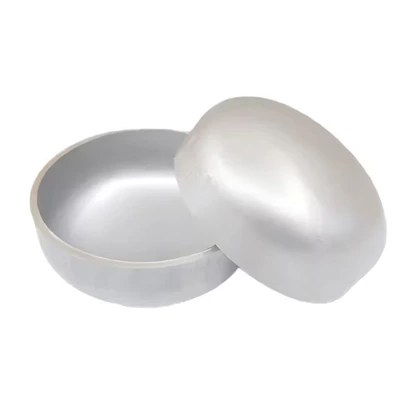
Producing a heavy buttweld end cap through thermal forming preserves uniform crown thickness. Heating eliminates excessive springback, ensuring the rim matches pipe bevel tolerances specified under ASME B16.9 standards without extensive secondary machining operations.
| Nominal Diameter | Wall Thickness | Preferred Process | Primary Advantage |
|---|---|---|---|
| NPS 2 to 12 | Under 12mm | Cold Deep Drawing | High surface smoothness |
| NPS 14 to 24 | 12mm to 25mm | Cold Spinning | Low tooling investment |
| NPS 26 to 48 | Above 25mm | Hot Press Forming | Uniform grain structure |
| Above NPS 48 | Heavy Wall | Hot Segmental Forming | Handles extreme thickness |
Material Behavior and Metallurgical Factors
Austenitic alloys exhibit severe work hardening during cold fabrication cycles. When manufacturing thick stainless buttweld caps, extreme wall thickness demands intermediate solution annealing stages if cold processing is chosen, which raises cycle times and manufacturing expenses.
Hot forming heavy stainless steel buttweld caps requires strict atmospheric control. Heating prevents excessive strain-induced martensite formation, yet post-forming solution heat treatment remains mandatory to dissolve precipitated chromium carbides and restore corrosion resistance along the knuckle radius.
Quality Verification for Heavy-Wall Caps
Wall thinning represents a primary inspection concern at the cap knuckle area. Severe plastic flow pulls material outward during hot pressing, requiring starting blanks with calculated oversize thickness to guarantee minimum code compliance after final calibration.
-
Ultrasonic wall thickness measurement across the knuckle radius
-
Magnetic particle examination along cold-formed transition zones
-
Liquid penetrant checks across seamless weld bevel preparations
-
Dimensional verification against ASME B16.9 ovality limits
Process Verification Steps
-
Calculate thinning allowances based on nominal thickness and curvature radius.
-
Verify press tonnage against blank yield stress at chosen forming temperatures.
-
Determine mandatory post-forming thermal treatments based on base metal chemistry.
-
Select non-destructive testing procedures capable of penetrating heavy wall cross-sections.
Dimensional geometry dictates process feasibility. Aligning outer diameter, wall thickness, and alloy characteristics ensures structural integrity while avoiding premature tooling failure or costly component rejection during pressure testing procedures.