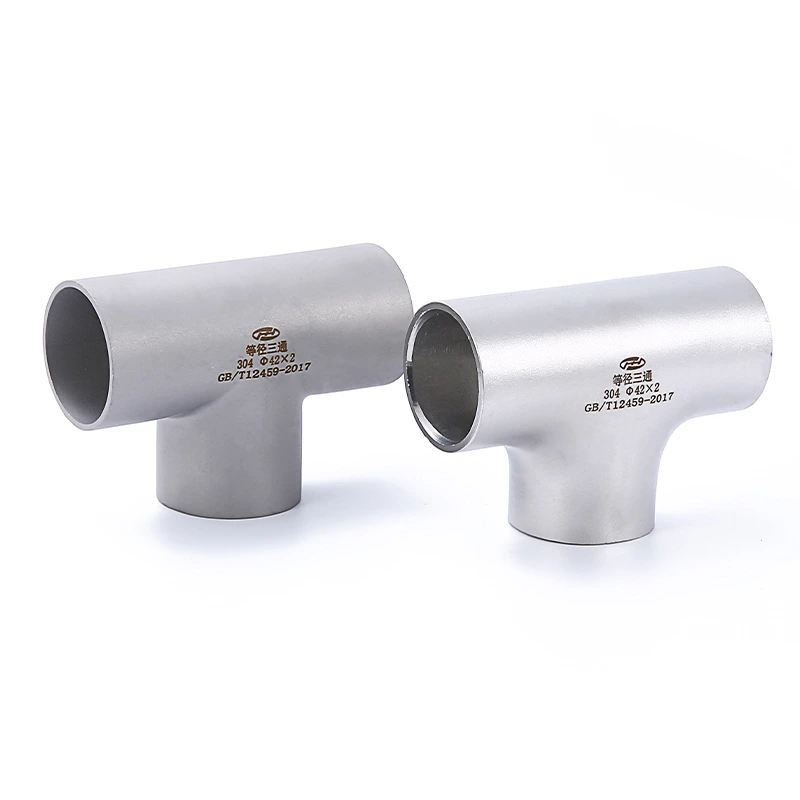
Butt Weld Tee Working Pressure Guide: High Versus Low System Decision Rules
High-pressure and low-pressure piping lines require distinct component geometry and wall thickness to handle fluid force safely. A butt weld tee splits or merges process streams, matching connected pipe schedules to maintain structural integrity across fluctuating line loads.
The Pressure Watershed Between Low and High Regimes
Operating boundaries shift around 1.6 MPa (232 psi), the typical threshold separating utility services from severe process lines. ASME B16.9 dictates that fittings match pipe pressure ratings through equivalent schedule thicknesses, preventing localized pipe wall thinning under steady stress.
Low-pressure systems prioritize flow volume and capital efficiency, whereas high-pressure regimes demand thick-walled weld tee fittings capable of handling cyclic pulsation, water hammer, and thermal fatigue without structural micro-cracking along line transitions.
Low-Pressure Scenarios: Flow Efficiency and Light Wall Sizing
Utility cooling loops and atmospheric discharge lines rarely exceed Class 150 ratings. In these runs, Schedule 10S or Schedule 40S configurations provide adequate hoop stress resistance while minimizing installation weight and overall fabrication expenses across wide facility footprints.
Standard Utility Applications
Standard low-pressure selection prioritizes fluid velocity balance and structural weight control across utility networks. Specifying correct components prevents premature pipe erosion while keeping installation costs reasonable:
-
Cooling distribution lines: A stainless steel reducing tee maintains line velocity while stepping down flow diameters into auxiliary equipment without causing excessive backpressure or localized cavitation within continuous circulation loops.
-
Low-velocity header tie-ins: A 6 stainless steel tee provides ample volume for dual-pump discharge lines operating below standard flange ratings, avoiding unnecessary weight on structural pipe racks.
High-Pressure Scenarios: Wall Integrity and Stress Concentration
Severe chemical reactors and high-pressure steam lines generate intense internal hoop stress. Piping layouts mandate Schedule 80S, 160, or XXS wall profiles to prevent premature fatigue failure at the crotch radius, where mechanical stresses peak during operation.
Severe-Duty Processing Applications
High-pressure selection requires targeted verification against dynamic shock and cyclic pressure spikes. Severe-duty piping layouts demand robust components capable of sustaining mechanical forces without deformation:
-
Hydraulic injection circuits: High impulse loads require a stainless steel unequal tee forged from seamless stock, preventing mechanical split failures along the branch junction under sudden valve closures.
-
Superheated steam bypass: Elevated temperatures reduce allowable material stresses, demanding full penetration tee butt weld joints inspected through radiographic testing to certify joint density and root integrity.
Technical Pressure Classification Reference
| Pressure Class | Standard Rating | Common Wall Schedule | Material Grade | Non-Destructive Examination |
|---|---|---|---|---|
| Low Pressure | Class 150 | Sch 10S - Sch 40S | 304L / 316L | Visual Inspection, Hydrostatic Testing |
| Medium Pressure | Class 300 | Sch 40S - Sch 80S | 316L / 321 | Liquid Penetrant Examination |
| High Pressure | Class 600 - Class 1500 | Sch 160 - XXS | 316Ti / 2205 Duplex | Full Radiographic Examination |
Decision Logic for Specifying Branch Fittings
Calculating required wall thickness using Barlow's formula ensures wall containment under maximum design spikes. Branch sizing choices dictate whether to specify equal run branches or reduced outlets, keeping velocity profiles within permissible erosion boundaries across operational lifespans.
Matching base metallurgy to process chemistry prevents stress corrosion cracking under elevated mechanical loads. Properly selected butt weld tee components withstand rigorous pressure cycles, ensuring continuous containment across utility services and demanding processing facilities.